
Knowing that a bolt has been tightened is not the same as knowing the preload that was achieved—or whether it remains within the intended range during operation. Different measurement methods provide different levels of insight: some estimate preload during installation, others verify it at a specific point in time, while sensor-equipped bolts can monitor changes continuously.
This guide compares the most common methods for measuring bolt preload, the factors that influence their accuracy, and when point-in-time measurement or continuous monitoring is the most suitable approach.
What does it mean to measure bolt preload?
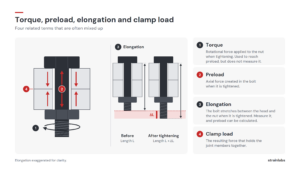
Preload is the axial force created in a bolt when it is tightened. The tension in the bolt creates a corresponding clamping force that holds the joint together.
Torque is the rotational moment of force force applied during tightening and is commonly used to achieve an intended preload, but it does not directly measure the preload.
Bolt elongation is the physical stretch of the bolt caused by tightening. By measuring this elongation, the preload in the bolt can be determined.
Clamp load is the reaction force that clamps the joint members together.
Achieving the intended preload during installation is important, but preload can also change after installation and during operation. Therefore, depending on the application, it may also be important to verify or monitor how preload develops over time.
Why torque does not directly measure preload
Torque is an installation parameter and an indirect way of estimating preload. There are many variables in a bolted joint, which means that even two bolts from the same manufacturing batch can produce different results when the same torque specification is applied in the same application.
Several factors can influence the relationship between applied torque and the resulting preload:
- Friction and surface conditions: lubrication, surface roughness, plating thickness and local variations in coefficient of friction.
- Threads and tolerances: dimensional differences, thread engagement, bearing surface area and thread tolerances.
- Tooling and installation: tooling capability, accuracy and installation conditions.
- Joint and operating conditions: variations in joint materials and external loads.
This is why torque should be understood as an indirect method of achieving or estimating preload rather than a direct measurement of preload in the bolt.
Methods for measuring bolt preload
The methods below differ not only in accuracy, but also in whether they estimate preload during installation, verify it at a specific point in time or monitor how it changes during operation.
Method | Measurement | Typical accuracy | Requirements and effort | Monitoring capability | Typical applications |
Torque control | Indirect; preload is estimated from torque. | Low–medium and highly affected by friction. | Calibrated torque tool; low effort during installation. | Installation only; unsuitable for monitoring remaining preload. | General assembly under controlled conditions. |
Torque-angle | Indirect; preload is inferred from rotation after snugging. | Medium–high repeatability in a characterized joint. | Controlled snug point and angle tool; low–medium effort. | Installation only. | Repeatable production and automotive assembly. |
Hydraulic tensioning | The bolt is stretched directly. | Medium–high; final preload is affected by load-transfer losses. | Hydraulic equipment and good bolt access; medium–high effort. | Installation or scheduled maintenance only. | Large studs, flanges, wind, power and offshore. |
Bolt elongation | Elongation is measured and converted into preload. | High when geometry, baseline and temperature are known. | Accessible reference surfaces and specialist equipment; high effort. | Mainly periodic measurements. | Critical large bolts, testing and validation. |
Ultrasonic measurement | Ultrasonic elongation is converted into preload. | High when correctly calibrated and temperature-compensated. | Surface access, preparation and trained operators; medium–high effort. | Suitable for periodic in-service inspections. | Critical joints and field inspections. |
Load cells and indicating washer | Direct or near-direct force measurement. | Medium–high, depending on the device. | Device installed in the load path; medium effort. | Point-in-time or continuous, depending on the system. | Testing, structural bolting and selected critical joints. |
Strain- or sensor-equipped bolts | Bolt strain or elongation is measured directly. | High when calibrated and temperature-compensated. | Sensor-equipped bolts and data infrastructure; low ongoing effort. | Automated or continuous monitoring during operation. | Critical, remote or inaccessible joints and condition-based maintenance. |
Accuracy is indicative and depends on the equipment, calibration, joint design, installation conditions and operating environment.
What affects the accuracy of preload measurements?
Accuracy refers to how close a measurement is to the true value, while precision describes how close repeated measurements are to each other for the same value.
Measuring instruments are often marketed with an accuracy of, for example, ±1%. However, this percentage should be complemented with a value for precision.
Strainlabs Bolts are calibrated to an accuracy of 99% and ±3% precision upon delivery. Translating this into an industrial situation means that a bolt with an actual preload of 100 kN will be measured to be 99 kN, with extreme values of a minimum of 96 kN and a maximum of 102 kN.
Strainlabs has designed the balance between accuracy, precision, battery lifetime, cost and user-friendliness. Since several parameters are driven by software, many of the settings are adjustable to specific requirements and applications.
Temperature and thermal compensation
Preload is not the only factor that can affect bolt elongation. Temperature changes can affect both the bolt, sensors and electrical components used for measurement. Since Strainlabs Bolts contain sensors and electronic components, the measurement needs to compensate for the effects of temperature on both the electronics and the elongation of the bolt. This compensation needs to be accurate and repeatable, including in environments with changing temperatures.
Strainlabs Bolts therefore measure temperature every time a preload value is measured. With the standard measurement interval, this takes place every 10 minutes.
Each Strainlabs Bolt and its components, including the PCBA (Printed Circuit Board ASSEMBLY), is calibrated to ensure that the preload value is correctly compensated for within the specified operating temperature of -30°C to +70°C.
Strainlabs Bolts measure preload using an LED sensor. The measurements would be inaccurate without efficient compensation for the thermal effects on the steel and electronic components. In Strainlabs Analytics, the temperature value is plotted on a graph alongside the preload measurements.
Installation measurement vs continuous monitoring
Torque is an important part of the installation process, but it does not tell the whole story. It provides an important input during installation, but it does not tell us what happens to the bolted joint over time.
Strainlabs has developed a system that enables continuous monitoring in every sensor-equipped bolt. This helps maintenance teams follow preload over time after installation and automatically and remotely follow up bolt preload.
Achieving and maintaining bolt preload is critical for the external forces and environmental challenges that the bolted joint can withstand.
The main difference is therefore whether preload is checked or estimated at installation, or whether changes in preload can continue to be followed during operation.
Which preload measurement method should you choose?
The appropriate preload measurement method depends on the application and what information is required.
Point measurements can be a suitable option when the application is easily accessible, when measurements can be taken as part of scheduled maintenance, or when the bolted joint is known to change slowly over time. Installation measurement is particularly valuable for critical bolted joints, as verifying the achieved preload provides information about the condition of the joint from the start.
Continuous monitoring becomes more relevant when access is difficult, when changes in preload over time need to be followed, or when the consequences of an unplanned stop are significant, for example due to production loss, equipment failure or safety risks. In these applications, continuous monitoring can provide information about both the initial preload and trends over time, while alerts can indicate when preload deviates beyond defined limits.
Factors to consider when choosing a method include:
- how critical the bolted joint is
- number of bolts that need to be measured
- accessibility of the joint
- temperature variations and vibration
- required measurement accuracy and repeatability
- how frequently measurements are needed
- cost and time associated with manual inspections
- consequences and cost of unplanned downtime
How Strainlabs measures bolt preload
In Strainlabs Bolts, the light intensity is based on a cavity in the bolt. A small hole is precision-drilled in the bolt along its axis to create the cavity. When the bolt is tightened, the cavity is elongated together with the bolt.
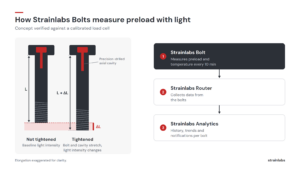
The result is a change in light intensity that can be measured. This means that measuring preload with light is possible. The concept is verified against measurements with a calibrated load cell.
Strainlabs sensors measure temperature every time a bolt preload value is measured, allowing the preload measurement to be temperature-compensated.
The measurement data is collected by a Strainlabs Router and transmitted to Strainlabs Analytics.
Each bolt can be assigned a position in Strainlabs Analytics, creating a digital representation of the monitored installation. The information can be structured on four levels:
- Sites
- Machines
- Joints
- Bolts
From preload measurement to maintenance decisions
The ability to identify patterns and trends in measurement data is becoming increasingly important in industrial maintenance. Measurement data and statistics can provide maintenance teams with more information for making decisions and identifying changes that may require further investigation or action.
Strainlabs Analytics is designed to visualize the status of bolted joints and enable remote monitoring of multiple joints, machines and sites.
Each bolt has a unique ID and keeps a history of the changes and events associated with that ID. Notifications display messages from monitored bolts so that changes can be acted upon proactively. Logs stored in Strainlabs Analytics provide historical data that can be used for reflection, analysis and improvement.
Instead of relying only on scheduled inspections, maintenance teams can use preload history, trends and notifications as additional information when deciding which bolted joints require attention.
Manual inspections during operation involve both risks and costs. Remote monitoring can reduce the need for manual inspections by allowing bolts to be visited or retightened when needed.
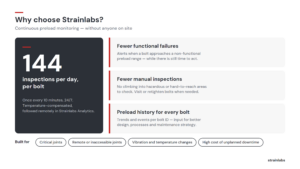
Data from Strainlabs Bolts can contribute to more efficient use of maintenance resources, increased equipment uptime and help avoid functional failures. Safety can be increased both in terms of product safety and personal safety, for example by reducing exposure to harsh environments. Preload insights can also be utilized to improve design, processes and the overall maintenance strategy.
The ability to follow up whether the preload achieved in the bolt from the start was correct is valuable for safe and efficient operations.
When a bolt goes from being only a mechanical component to also becoming an automated measuring tool, it can provide information about the condition of the bolted joint.
This can support:
- Reduced risk of functional failures: Strainlabs System can provide alerts when bolts approach a non-functional preload range.
- Smart maintenance: automated monitoring can reduce manual inspections, particularly in hazardous or difficult-to-reach areas. Time otherwise spent on manual inspections can instead be used for other activities.
- New insights: stored mechanical data can provide information about how bolted joints behave over time and support improvements in maintenance and engineering.
Conclusion: From measuring preload to understanding it
Measuring bolt preload is important. But for critical bolted joints, knowing the preload at installation is only part of the picture. What happens when operating conditions change, vibrations occur or preload gradually decreases over time?
For industries where joint reliability is essential, having access to this information can make a significant difference.
Strainlabs helps bridge the gap between knowing the initial preload and understanding how critical bolted joints behave throughout operation. This gives maintenance teams a stronger foundation for making informed decisions and addressing potential issues before they develop into larger problems.
Every application is different, but the need to understand what happens inside critical bolted joints is shared across industries.
Choosing a new monitoring solution involves several considerations. Whether you are looking to improve reliability, gain better control over critical bolted joints or explore a more proactive approach to maintenance, our team can help you evaluate the possibilities and find the right approach for your application.